Matty painting the undercoat

Plaster and paint, oh my I might faint…

Since the last coat of render, Cooinda’s Nest has been going through a slow and steady transformation. Who knew painting the plasterboard walls and ceilings could make the house look more like a home?  Well I didn’t, but it is my first time building, so let’s excuse my ignorance. Matty and I have to keep reminding ourselves that there is yet more work to be done, till we can truly call it a day… or a year really.

Plastering joy

Matty used to be a plasterer for about 12 years, so this phase of the project ran pretty smoothly; albeit the frustrations of simply doing it. Within a week, Matty completed the base coat, first, second and last coat of plastering as well as sanding it all back.

Picasso will be impressed

Matty and I considered hiring a professional painter to give us a hand, as we are quite over the build process and just want it finished.  Though as time ticked along, it seemed more prudent to do all the interior painting ourselves, and outsource only the exterior fascia and eaves. Help came from a painting/dirt-bike riding friend of Matty’s, Luke (aka Beefcake), whose expertise has helped us throughout this process. He was also generous enough to come for half a day to help Matty with the last coat of the ceilings. It’s taken 10 days to do all the interior painting, including undercoat, first and second coat.  All render surfaces will remain as is, and the external painting will be completed in late spring to ensure that the paint dries well (the temperature cannot drop below 10 degrees to allow for this).

We surely didn’t feel like fainting from the paint fumes, that’s because there weren’t any!  The Rockcote Ecostyle range is quite impressive with its zero volatile organic compounds (VOCs) certification. Colours come out beautifully too, and the texture is velvety. I didn’t think I could talk about paint like that before.  Stop me before I become one of those <insert item> connoisseurs!

Windows prep continues

During this time, I have been cleaning window frames and sills in preparation for another coat of oil (interior) or varnish (exterior). This seemingly simple task took the following attempts to remove the render sticking into little crevices of the timber:

  • wiping them down with two types of sponges and water to remove any render (x 3 times)
  • wire-brushing areas to remove any sticky tape residue (once)
  • wet tooth-brushing (x 4 times)

There is still sanding to be done prior to applying the oil or varnish as well. These windows and sills had better look as if they have had at least 100 hours of labour put in them! I’m no domestic goddess, and this house is probably getting cleaned more now than it ever will be in its full lifetime.  No joke.

9 (ish) week countdown

We have a rough estimate as to when we would like to move in, it is 2 Nov 2017, exactly one year since the slab pour. We don’t know whether this is feasible as there is a lot of bespoke work to be done.  In somewhat of an order, here are the remaining tasks:

  • final fix electrical
  • tiling
  • final fix plumbing
  • grouting the crazy paving tiles
  • oiling the windows and window sills (interior)
  • varnishing the windows (exterior)
  • complete the in-ground fish tank
  • complete the open fire chimney and flue
  • full bathroom fit-out
  • full kitchen fit-out
  • painting the fascia boards and eaves
  • making the cabinetry for the walk-in-robes in both bedrooms
  • making our bed frame
  • making the bookshelves
  • building the pergola
  • landscaping

It’s quite an extensive list, but I feel more enthusiastic when I think about how far we’ve come in a relatively short period of time. Spring is on the way, and so is our home… can’t get sweeter than that :)

Mask up, bog down, render right around…

Exactly a week ago, the third (and final) coat of render took place on the eve of the Leo new moon. Matty and I woke up at 5:40 am on Saturday July 22nd, worried for the upcoming day; little did we know then that we were to be blessed in almost every way.  Sipping our morning coffee half an hour later,  we spotted a silvery crescent moon sitting atop the house, a position of the moon we had never witnessed whilst living on the property for over a year.  To us this was a blessing, and it lifted our spirits to no end.

Render prep

Matty and I spent a week in preparation, masking up windows, kitchen cabinets, doors, door frames and the new fireplace. In addition, the gaps around the windows and doors had to be bondcreted and pre-bogged with render. The whole process is a mammoth task, and we are indescribably happy that it never has to be repeated again. Our hands, skin, energy levels, morale and enthusiasm have all been compromised. I am not making these statements to put anyone off from owner-building, but simply painting a realistic view of the situation.

On the day

By 7:30 am, 8 helpers (friends of ours), Mark (the render man) and his son Robbie, Matty and I began on what was a 11 hour render mission.  We made an awesome team and got the work completed on the same day; something that Matty and I were striving for, but unsure whether enough time and day light hours would assist.  Matty and I cannot thank our friends enough to give up their weekend time, and do hard physical labour just to give us a hand; this support is never to be forgotten by us. I am sure the helpers will never forget either… it isn’t pleasant work, and don’t be fooled by anyone who tells you so. A big shout out to Ron, Luke, Chris, Sam, Val and Benny Boy! This house is no doubt a labour of love, of perseverance and support.

The weather gods had blessed us tremendously with no rain on the day, and no frost the following morning either.  The third coat of render is heavily dependent on the weather as it is the final finish.  There isn’t much to say about the rendering process as it hasn’t differed from the first two coats, except the ratio of the ingredients. This time round the render mix consisted of 75% sand, 20% lime and 5% clay and was 10 – 20 mm thick (similar to the first coat). Aesthetically, the major difference also lies in the render finish which is now smooth.  Our undulating wavy strawbale walls are softened, corners seem to vanish and the play of light and shadows is simply stunning.  We love the earthy, organic presence of our future home; it is exactly what we were after.

A week later

Post render clean-up was the task for the past week, which included taking all the plastic cover sheets off, taking staples out of wooden surfaces, scraping the floor, plasterboard and cement sheets free of render, cleaning window frames and then wheelbarrowing the debris into a hole in the ground. Now that we are here, the next phase can begin.

The real, ‘really-real’ finishing touches phase

A new tiny surge of enthusiasm seems to be filling our hearts again; as we are truly at the finishing stages now with Matty plastering next week, myself picking up paints and slowly but surely getting there. Matty and I are over the build process, but the end result will be worth it all.

We have started to realistically imagine living in there. It may seem strange to you, but when you start the build process, you have an idea and run with it (the creative stage). Then the task of making it into a reality begins, and you get so caught up in how to build the damn thing, you kind of forget what made you get here (the physical stage). I think we are the tail end of this now…. the third phase is simply living in it.  Your creation that you have thought of, is a solid, supportive and tangible home, one that speaks to you and the surrounding nature.  This is the culmination of our dream and hard work, with the support of friends and family. It is a strange and beautiful thought, of living in a dwelling that has had so much energy put into it.

Anyway, enough of my philosophical musings; spring is on its way and that in itself keeps us going…

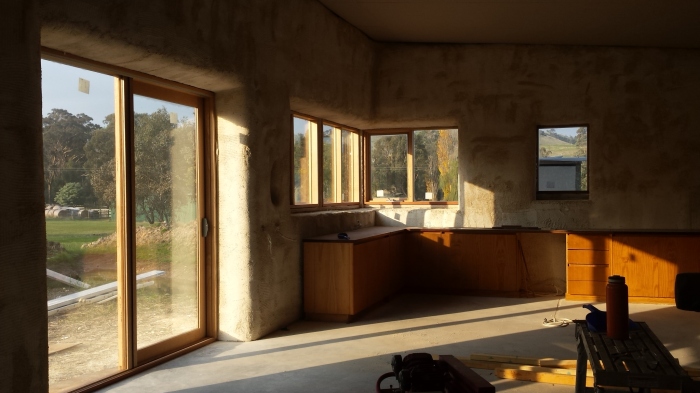
Winter warming sunlight streaming through the front door

Winter is here

Without trying to sound all negative and stuff, but it is winter.. and I can’t shake the cold off. The time has come for when the world slows down and allows you to recuperate and reenergise, just through simple rest; something that I feel we may have forgotten how to do. Thankfully the build stage agrees with this seasonal change, and gives us a chance to slow it down and go with the flow.

The last few months have been a whirlwind of major structural work, and the tasks were all BIG! Now, as winter settles in, the attention goes inwards.

The open fireplace

One new addition of Cooinda’s Nest is the open fireplace.  Matty and I had a cast iron wood heater in mind to do the job, but we were seduced by an outing to the local pub, where we sat in front of the open fireplace with Dad and Di (aka Mum).  The ambience of an open fireplace is something hard to come by, or to match; so we opted for the better option instead.

To avoid the painstaking task of bricklaying (Matty shuddered at the thought of the besser block wall), we decided to hire a professional bricklayer with some experience in making open fireplaces.  Thankfully we found someone local who was fit and available for the job.  All that remains now is to attach the flue, chimney, cowling and damper to finish the fireplace.

Besser block ‘crazy’ paving tiles

The next big addition is the ‘crazy’ paving tiles that have been laid on the besser block wall in a half-moon shape.  They serve a purely aesthetic purpose, and were placed on both sides of the wall, meaning they are visible from the main living area and the bedrooms.

Other bits and bobs

Besides these two changes, it may seem that no major changes are happening.  However, we now have completed some essential tasks such as getting the plumbing prepped up, and doing another round of electrical work.  Our bedroom fan units were mounted along with the bedroom reading nook cabinet now being complete with doors and latches. All other doors in the house now have door handles and latches as well.

A lot of sanding and varnishing is now complete, with the kitchen benchtops and brekky bar slab, as well as the timber worker’s bench vanity table all ready to go in. All 10 window sills are also complete after much sawing, wire-brushing, sanding and oiling. Niches now have shelves, the bookshelf spine is now erect and the laundry divider can be installed after the third coat.

Friends from overseas (Ron, aka Girly Man) and interstate (David, aka Shorty) lent us a hand with third coat prep and stuff and that! Thanks for being awesome mates :)

Where to next?

The third coat of render is booked in from a fortnight from now, giving us enough time to prep for it.  Everything that needs to be protected must be masked up thoroughly, Matty estimates this taking up to 3 days.  Once the render is complete, we reach the final ‘finishing touches’ phase, including painting and tiling.  We’re on the home Hume run baby!

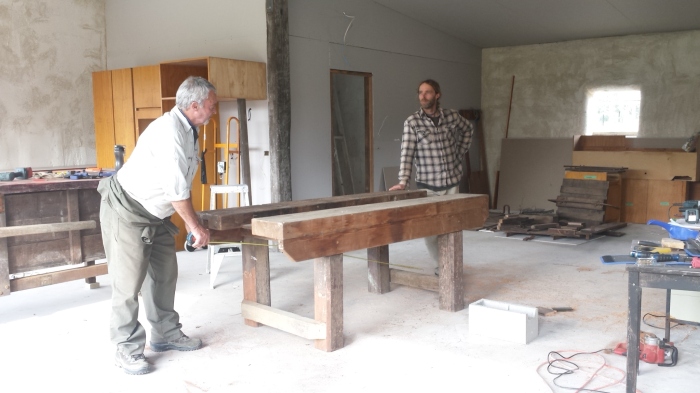
Dad and Matt talking builder talk

It runs in the family

It has been an inspirational and exciting four weeks since the last post, getting so much done and being fortunate enough to receive much-needed (and appreciated) help from family.

Matty’s father and his partner, Di flew from New Zealand to give us a hand with cabinetry and other timber related features of the house, like the breakfast bar and the bathroom vanity. Both Matty and Dad got to play their talents whilst spending quality father-son time, which was really what it was all about :)  Dad used to be a builder/carpenter back in the day, and Matty had wanted his help even before we bought Cooinda.

To top off all the achievements with Dad and Di, in no particular order:

Kitchen fit out and cabinetry – Dad and Di retrofitted the second-hand kitchen to suit our new home…but first we needed to move it from the main shed to the house.  We all were happy to find that the kitchen fit our space like a glove, with some cutting and nailing of course ;)  The timber surfaces still need the finishing touches like sanding and varnishing, but other than that, they’re good to go.  The kitchen island, breakfast bar and bathroom vanity had to be taken to the main shed as we need to finish tiling first.  Our neighbour Ken was kind enough to lend us his tractor for some of this heavy lifting.


Internal and external doors – Matty constructed all three internal doors from recycled timber floor boards, he also made the door jams and frames and fitted in the one external timber door.

Matty and I cannot thank Dad and Di enough for taking 12 days out of their busy lives to come give us a hand.  Not only did I get to meet the old man for the first time, but we all got to spend some quality family/ building time together.  We can’t wait to see them both at our wedding next year! Yipee :D

Lock up

Less than a week since Dad and Di left, we also managed to get all the windows and main door (which is a double sliding door) mounted.  This means that we are now sealed from the wintry frost and winds.  We placed insulation blankets at the bottom of the back door and closed all windows and doors, to get a glimpse of the sound insulation properties, and we were not disappointed. Most if not all of the Hume Highway traffic was drowned out, a massive bonus! We are super happy with how the windows turned out, the Vic Ash timber varnished with natural oil really is stunning (I still need to do another coat of varnish) and the double glazing has definitely paid off :) Honourable mentions go to neighbours Cam and Benny Boy, whose help meant we got to reach lock down mode on Mother’s Day.

The only outside tasks that now remain are mounting the cement board sheets for the eaves and painting the fascia boards, and of course the third coat of render, but let’s put that one aside.

We are now at the precipice of the ‘finishing touches’ phase, and perhaps this part will take the longest…I know I know, there are things like plumbing, electrical work, tiling, painting, making window sills etc.; but some of these are the ornaments of the house, and we can’t wait to adorn her…

The morning after the second coat

Second skin

The house got to bathe in the Libra full moonlight with its freshly covered second coat on April 11th and 12th.

Mark and his assistant (the professional render team) arrived on the morning of April 11th, along with our friends Val, Charlotte and Benny Boy to help us with the second coat. Matty had envisaged the whole task taking about 8 hours each day, but thankfully we finished up around 1 pm on the second day; giving Matty and I time to celebrate this special milestone.

The second coat had to be followed by someone trowelling by hand after the render pump (unlike the first coat), and this trowelling started to give the walls a somewhat zigzagged, yet smoother finish. This time round the render mix consisted of 75% sand, 15% lime and 10% clay and was 30 mm thick (triple the thickness of the first coat). This thick coat is so important in terms of creating that waterproof barrier; the third coat will also assist in this but it will be heavily focused on the aesthetic appearance as opposed to this functionality. The thickness also means that 99.99% of all straw is now covered, leaving no loose material for fire to catch on to. There are still some minuscule lips of straw sticking out, but these will be covered by the third coat of render.

Precoat and postcoat

The walls needed some extra patch up work before the second coat, and we had some helpful hands then as well.  Matt’s business partner/best friend Joe assisted with this task whilst visiting Melbourne.  This patch work was needed to smooth out any large dents or grooves from the first coat, and also ensured that the second coat would have a much more consistent finish. During this time, Matty also carved out the niches and holes in the walls where the glass blocks will be inserted. These were the humble beginnings of the house’s aesthetic features, and it is nice to visualise the finishing touches.

Friends from Sydney visited us during the Easter break to have a holiday and see Melbourne for the first time.  Ani and Mimi helped clean up the second coat mayhem, and hopefully we helped impart some info regarding owner building as they are keen on doing something similar someday.   Matty and I are very thankful of their time and contagious enthusiasm.

As winter is near, Matty and I are now on the fast track to get the windows and external doors in, only then can we start on possibly one of the most exciting stages – the internal fitout!


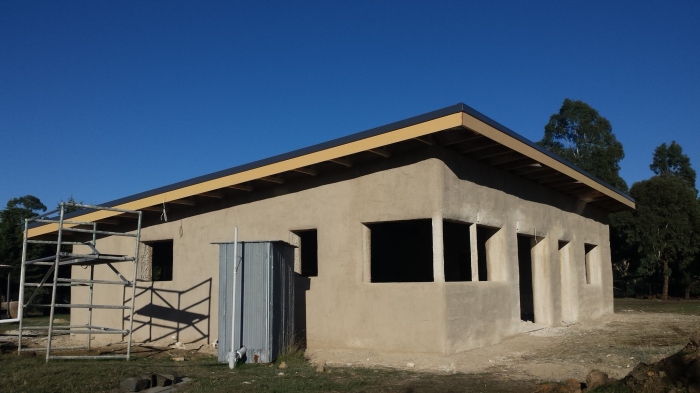
West side - round 1 complete

First skin

The house finally got its first layer of skin yesterday, thus marking the beginning of the longest milestone. The third and final coat of render will not be applied till all the internal fit-out is complete, which we estimate to be late winter/early spring.

To say that this past week has been hard is an understatement. Thankfully everything went smoothly on the day, and all the hard work was worth it all, especially for the view of the house from the driveway.  As the Grand Design peeps love to say: “it blends into the environment”, and for once Matty and I seem to think so too!

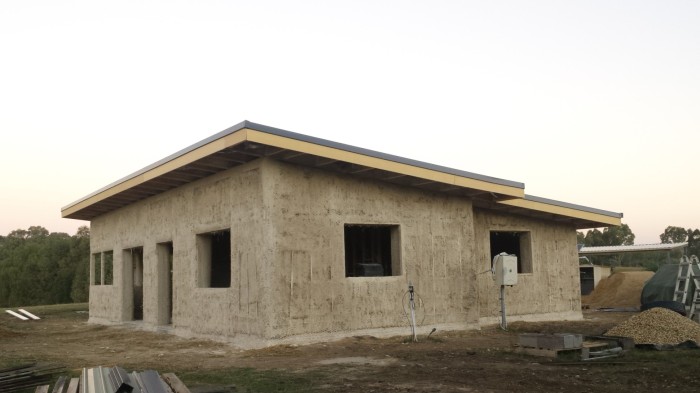
View from the driveway
The house blending into the environment

Render prep

Prior to the render going on, all the timber frames, lintels, posts, top and bottom boxing had to be covered by mesh and then stuffed with straw; bondcrete also had to be applied to any other exposed timber areas that couldn’t be meshed. These two processes were to ensure that the render sticks to it and also creates a marriage between the two surfaces (the timber and the straw), so that the render can bind to both. The meshing and straw stuffing is monotonous work, but thankfully Sam and Benny Boy came to the rescue and helped unburden some of Matty’s workload.


Professional renderer

We hired a professional (Mark) who specialises in rendering strawbale buildings; Matty had met him at the strawbale workshop he attended last April, and thought it wise to use his services.

Five people (inclusive of Matty and myself) worked for over eight hours yesterday, completing the inside and the outside strawbale walls of the house. Mark used a render pump, essentially something similar to a concrete pump that pumps out render onto the walls; the render mix is made on site whilst the pump is going.


Natural render

The natural render mix consisted of the following ratio of ingredients: 75% sand, 15% clay and 10% lime. We had to do test patches with various ratios about a week before to ensure that the render will not crumble after drying. The first coat should also crack a little once set, which is a sign that it has bonded well to the walls. The consecutive coats of render will have increased amounts of lime and less amounts of clay.

The clay in the mix is the bonding ingredient, and helps the mixture stick to the strawbale walls. The lime hardens the mixture, and the sand is the showstopper. The colour, texture and quality of sand is what gives the house its final colour, unless of course you want to add an oxide which is purely there for aesthetic purposes. I was initially pro oxide use, but now that I see the somewhat finished effect, I have changed my mind and want to go all au naturale. This is Matty’s preferred option for two reasons: 1) the oxide mix cannot guarantee that the finished colour of the render will match expectations 2) oxides are very costly and will definitely blow our budget.

Second coat

The second coat of render will take two days to complete, this is because it will be about 30 mm thick compared to the 10 mm thickness of the first coat. Mark and the render gang are due to meet again for the second coat in a fortnight from now, giving the first coat ample time to dry and set properly.

The house currently looks a bit like play-doh, lumpy with straps and mesh sticking out.  We will fill the uneven surfaces with cob and staple the mesh in to ensure a flatter surface between now and the next round. Nonetheless, Matty and I are proud parents, patiently waiting to see the house blossom after its awkward teenage phase.

All bales are in, strapped up and braces removed!

House of straw

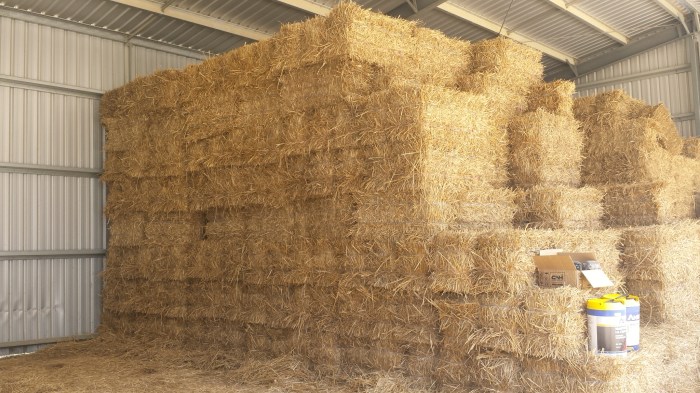
Two and a half weeks ago the first round of strawbales were delivered, and then four days later, the second batch.  All up we have 350 bales in our possession, and they are more than enough for the house… a few will be leftover which will get used in the chook pen, much to the chooks’ delight I’m sure!

Round 1 of bale delivery, 175 bales for our building pleasure

Laying it all down

When building the strawbale walls, it may seem simple enough to plonk the bales on the bottom boxing and then layer them as you build height, but there’s more to it than that.  Here’s a list of things to consider:

  • side of the bale facing the inside or the outside of the house, and each row must alternate from the previous one to ensure that the wall doesn’t bow. This is due to the fact that the bales have a more compact side and another fluffier side, thanks to the machine that cuts them
  • notches must be cut out of the bales when there are timber frames in the way
  • bales will need to be cut to size (using a bale needle) to fit into places
  • bales are always laid in a running bond (brick like manner) for sturdiness

Saying all this however, I feel that this part of the build was one of the most satisfying as progress happens relatively fast. It’s instant gratification when you see the house of your dreams literally being conjured up in front of you, after a lot of huffing and puffing of course…yes I HAD to throw that in there ;)

Feeling the tension

One of the more common questions we get about using strawbales is its fire risk. Living in rural Victoria this is obviously something that we took into account, especially as the previous house on the property had burnt down during Black Saturday.

Loose straw is extremely flammable, strawbales are also flammable however the earthen render that will cover them eventually negates this risk.  The strawbales get tensioned down to make them dense, which helps remove air pockets and transforms them into an unmovable barrier. This density is what aids in its amazing sound and thermal insulative properties also.

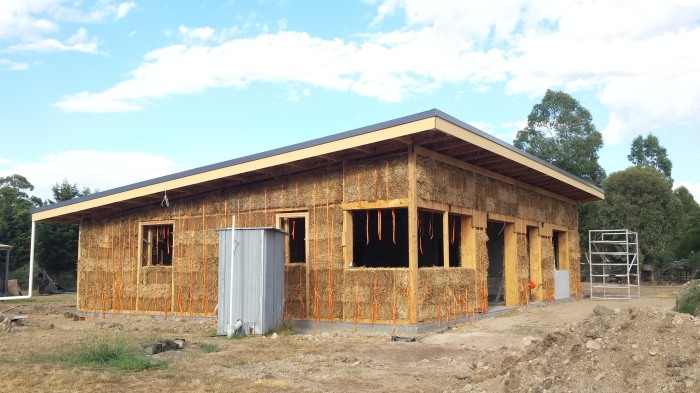
Tensioning is done in 3 stages to ensure maximum compactibility; and though not fire-proof, the fire resistant properties of compacted straw is very good.  I like to think that the house now has a kinky side as the tensioning straps look like orange suspenders…. yes I am weird :D  The straps will remain to ensure the walls remain steady and the first coat of render will cover them in a few weeks’ time.

Since we don’t have a video camera to take a time-lapse video, I have attempted to (somewhat badly) capture the progress of the walls going up on north-east side of the house.


Some more photos with the changes from the inside, with the kitchen in view.

Helping hands

Thanks to Ryan and Alex for giving up your free to time to come lend us a hand, and Fisher and Robin for trying to help us with our finances!  A few hours of help was also received from our local Benny Boy, whose amusing stories and strong arms keep up the building spirit. Matty and I are very grateful :)

Next up, it’s gonna be da na na na… na na hammer render time!

Battens, cables and bales

It is nearly time for the house’s most distinguishing feature to be delivered. Matty and I went to inspect the bales this morning, and they are mighty fine. I ain’t any bale connoisseur but these bales definitely looked like they could be the muscles of our house (the render will be the skin, the frames are the bones….important to get these anatomical details correct :D :D). Each of these wheat straw bales measure 965mm(W) x 450mm(D) x 375mm(H), making the walls quite thick and insulated. 350 of these bad bales will be delivered next week, and the remaining 100 a fortnight after.

Last week we completed putting up all the roof battens, and Jules (the sparky) spent a day with Matty roughing in (installing) all the electrical cable wiring through the house. These had to be done prior to bale insertion as some of the cabling will need to go through the straw. Now all that remains is to set up the straps and ply in the bottom boxing so that the bales can be tensioned down once in place.

This post is short and sweet, but the next one will commemorate the walls going in,  another milestone for the build!

A roof over our heads

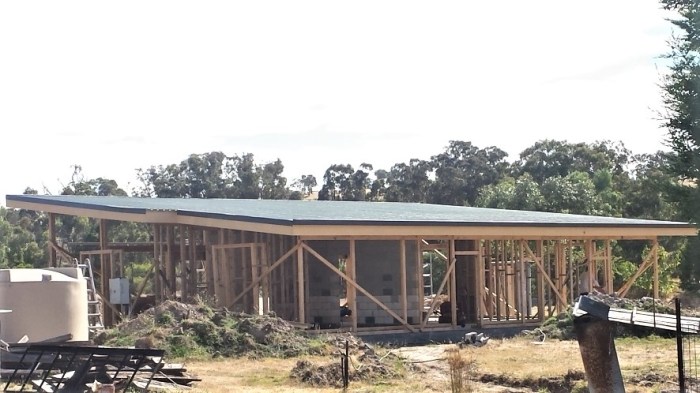
The last day of January marked another milestone on Cooinda, the roof sheets were put up!  Three days later, Matty secured the flashing around the edges as well.

Tim, the plumber assisted Matty on the day.  As the skillion roof is on a 6 degree single pitch, the gutter will only be on the south side of the house, where eventually a downpipe will feed a 10,000 litre rainwater tank. We then started work on the roof battens this weekend; this is the timber on the inside portion of the roof that holds up the ceiling plaster as well as the roof insulation bats.

Alongside the roof extravaganza, I managed to finish varnishing the remaining 3 large windows of the house, thus completing the first coat of varnish for all 10 windows.  The second coat will be done once the windows are in the house.

It feels a little strange albeit the excitement; the house has become more grounded, more ‘real’ since the roof went up. There is a sense of security that was previously missing, and I find it hard to put into words how much a roof makes a difference.  They don’t say “at least I have a roof over my head” for no reason.

It is Matty’s birthday next week, so we are off camping to a spot west of the Grampians for the weekend.  Once back, we will be organising a delivery date for the straw bales… the adventure continues :)

First fascia board is up

The first quarter

And so we are close to our first quarter since the slab pour; 3 months, oh how you’ve whizzed by!  We’re on the precipice of the roof inauguration (yes, I used that word with intent).

Last weekend we had hired help from our local Benny Boy, a quirky character who we buy firewood from during the colder months.  He has the strength that I lack, and he lacks the fear of heights that I have, so it worked out for the better :D  He helped Matty put up the smart roof joists (as opposed to the intellectually challenged type).   In case you were wondering (like I was)… smart joists refer to a brand name of laminated timber that are light and strong compared to “normal” (aka stupid) joists :D  Am I getting down with the building lingo or what?!?!

The smart joists run parallel to each other with a 900 mm gap, and run down the length of the house (north to south).  These then are accompanied with purlins that run across the width of the house (east to west) again with a parallel 900 mm gap.  Next on the to-do list are the fascia boards that circumambulate (oooooh I use big words, I must be smart, SMRT!) the entire roof board and provide support for the gutter.

We have only just mounted the first fascia board on the north-east side of the house, the others are intended to be done within the next week, along with all the electrical wiring and cabling that run through the roof.  Tim (the plumber) is scheduled in to help Matty put the roof sheets up, and tick off all the plumbing related requirements just after Australia Day.

Straya day long weekend will be long indeed!  Can’t complain though, walking through the house now with just the roof joists and purlins up made us get goosebumps, let’s see what the roof sheets going up does to our emotions…